Choosing the right orthopedic manufacturer is not a decision based on a polished website or a low quotation. It affects patient safety, product consistency, surgical performance, and long-term business reliability. A credible supplier should demonstrate technical competence, controlled production, and a clear understanding of orthopedic applications.
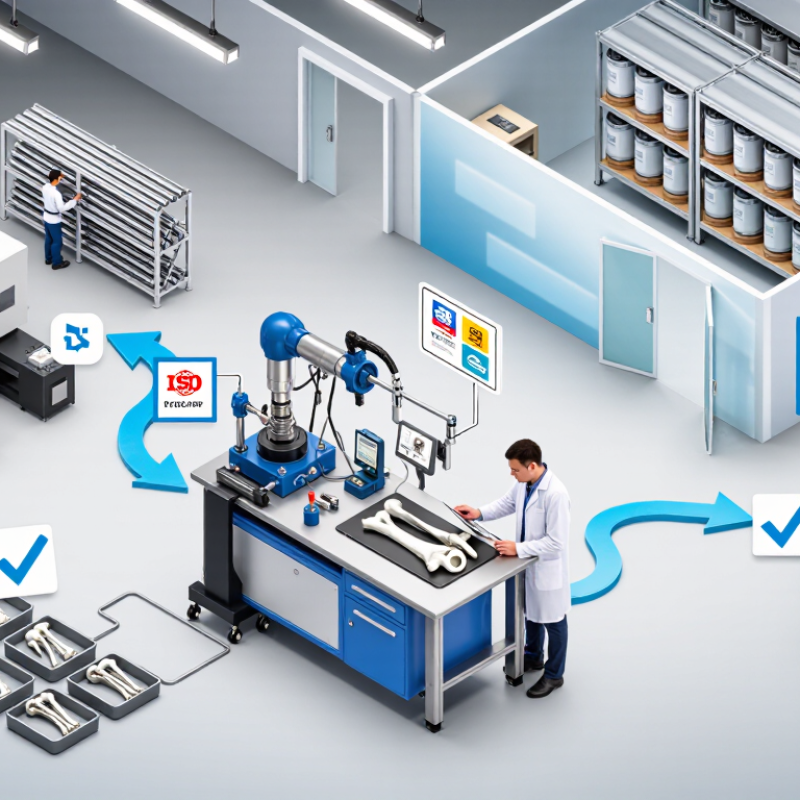
Look beyond the catalog. Ask how raw materials are verified, how instruments are inspected, and how each production batch is traced. Request current quality certificates, validation records, and evidence of compliance with the regulations in your target market. An experienced orthopedic manufacturer should explain these details clearly, without hiding behind general claims. Factory audits can reveal practical facts, such as whether inspection equipment is calibrated or whether finished implants are stored in clean, organized areas.
Small details matter.
Communication also deserves careful testing. Reliable partners answer technical questions directly, provide realistic lead times, and report problems before they become expensive. Their engineering team should support design reviews, sampling, packaging decisions, and post-market feedback. References from hospitals, distributors, or established medical companies can add valuable perspective.
No supplier is perfect. That is worth remembering. Even experienced manufacturers may face material delays, design changes, or occasional quality issues. The real question is how openly they respond and how effectively they prevent recurrence. Compare documented evidence, not promises. A thoughtful selection process may take longer, but it reduces avoidable risks and supports safer, more dependable orthopedic products.
How to Choose the Right Orthopedic Manufacturer?
The World Health Organization estimates that 1.71 billion people live with musculoskeletal conditions worldwide. This figure should shape your product strategy, not merely decorate a presentation. Define the clinical problem before contacting a manufacturer. Consider fracture fixation, joint replacement, spinal care, rehabilitation, or supporting instruments. Each area requires different materials, testing, manufacturing controls, and clinical expertise.
A capable orthopedic manufacturer should understand your intended users and treatment settings. Ask how engineers translate surgeon feedback into design changes. Request evidence of quality systems, material traceability, process validation, and risk management. Review sample inspection records, not only polished brochures. Manufacturing capacity also matters. A factory may produce excellent prototypes but struggle with consistent volume. That gap can affect delivery, training, and patient care. No checklist is perfect. I would still verify every important claim through documents, audits, and technical discussions.
Tips: Match the manufacturer’s experience to your exact product category. Examine tolerances, sterilization compatibility, packaging, and complaint-handling procedures. Ask for realistic timelines, including design revisions and regulatory review. Visit the production site when possible. Look closely at clean workspaces, calibration labels, operator training, and how deviations are recorded. A low quoted price may hide weak validation or costly rework. Choose evidence over confidence.
| Product Scope | Representative Conditions | Relevant Product Families | WHO Burden Indicator | Manufacturer Capability to Verify | Recommended Scope Priority |
|---|---|---|---|---|---|
| Spinal care | Low back pain, degenerative disc disease, spinal deformity, vertebral instability | Spinal fixation systems, interbody devices, vertebral augmentation products, surgical instruments, non-operative supports | Low back pain affected approximately 619 million people in 2020; WHO projects about 843 million cases by 2050. | Implant design controls, fatigue testing, imaging compatibility assessment, instrument compatibility, sterile-barrier validation, traceability and post-market surveillance | Very high when the target market requires spine implants or surgical systems |
| Large-joint reconstruction | Hip and knee osteoarthritis, end-stage joint degeneration, post-traumatic joint damage | Total joint replacement systems, partial replacement systems, revision components, bone-preparation instruments | Osteoarthritis affected approximately 528 million people in 2019, according to WHO. | Wear and fatigue testing, dimensional control, material and coating validation, packaging integrity, sterilization validation, surgical workflow support | Very high for hospitals and distributors serving arthroplasty demand |
| Trauma and fracture fixation | Upper- and lower-limb fractures, pelvic fractures, periarticular fractures, non-union and malunion | Plates, screws, intramedullary nails, external fixation systems, wires, pins and associated instruments | Fractures are a major source of musculoskeletal disability; product demand is closely linked to emergency, trauma and orthopedic surgery capacity. | Mechanical strength, corrosion resistance, material certificates, sterilization options, instrument durability, lot traceability and supply continuity | Very high where emergency care and trauma surgery are core channels |
| Sports medicine and soft-tissue repair | Ligament tears, tendon injuries, meniscal damage, cartilage defects and recurrent joint instability | Suture anchors, interference screws, repair sutures, fixation buttons, arthroscopy instruments and implants | Musculoskeletal injuries are among the leading causes of activity limitation and long-term disability worldwide. | Pull-out and cyclic testing, suture performance, insertion-tool compatibility, biocompatibility evidence and surgeon usability evaluation | High in markets with strong arthroscopy and sports-rehabilitation services |
| Hand, wrist, foot and ankle | Small-joint osteoarthritis, deformity, tendon disorders, forefoot disorders and ankle instability | Small-joint implants, mini-fragment fixation, osteotomy systems, fusion products, braces and specialized instruments | Osteoarthritis is a leading musculoskeletal condition and commonly affects the hands, knees, hips and spine. | Small-component dimensional accuracy, fatigue performance, anatomical fit, instrument ergonomics and procedure-specific packaging | High for specialty orthopedic and ambulatory surgery channels |
| Inflammatory and autoimmune joint disease | Rheumatoid arthritis, inflammatory polyarthritis and related joint destruction | Joint reconstruction products, deformity-correction systems, orthoses, rehabilitation aids and surgical instruments | Rheumatoid arthritis affected approximately 18 million people in 2019, according to WHO. | Long-term clinical evidence, implant survivorship data, patient-specific fitting capability and dependable replacement-part availability | High where chronic disease management and reconstructive surgery are established |
| Non-operative support and rehabilitation | Back pain, osteoarthritis-related mobility limitation, post-operative recovery, joint instability and muscle weakness | Braces, orthoses, compression products, mobility aids, rehabilitation equipment and home-use support products | WHO reports that musculoskeletal conditions affect approximately 1.71 billion people worldwide and are a major contributor to disability. | Sizing accuracy, comfort, skin-contact safety, durability, cleaning instructions, user testing, labeling and scalable production | High for broad-access, outpatient and home-care markets |
| Custom and patient-specific solutions | Complex revision, severe deformity, bone loss, unusual anatomy and difficult trauma cases | Patient-specific instruments, custom implants, 3D-printed components and case-planning services | Complex musculoskeletal disability frequently requires individualized treatment when standard products cannot provide adequate anatomical fit. | Digital workflow validation, design-to-production traceability, additive-manufacturing controls, dimensional inspection and case-specific quality review | Selective because customization increases engineering, documentation and production complexity |