Choosing a ring should involve more than metal, gemstones, and appearance. The way a ring feels during ordinary movement matters just as much. A comfort fit ring uses a gently rounded inner surface. This design can reduce friction when the ring slides over the knuckle. It may also feel smoother during warm weather, exercise, or long working hours.
Master jeweler and ring-sizing specialist David Geller captures the principle clearly: “A ring should feel secure, not restrictive.” That simple idea guides this introduction to the top 10 comfort fit ring styles. The selection considers practical details, including inner curvature, band width, weight, edge shape, and daily maintenance. Wedding bands, beveled rings, domed profiles, hammered finishes, and alternative-metal designs each create different wearing experiences. Some feel almost invisible. Others provide a noticeable, balanced presence.
Fit is personal, though. A wider band can feel tighter than a narrow band with the same size. Fingers may also swell after salty meals, warm travel, or hours at a desk. Measuring once is not always enough. That is an easy detail to overlook.
The styles ahead are not ranked by beauty alone. They are compared through comfort, durability, styling flexibility, and realistic everyday use. A polished interior may glide easily, while textured surfaces can require more cleaning. A rounded profile may suit active hands, but it may not match every preference. Small differences matter. Sometimes, the “best” comfort fit is simply the ring you stop noticing.
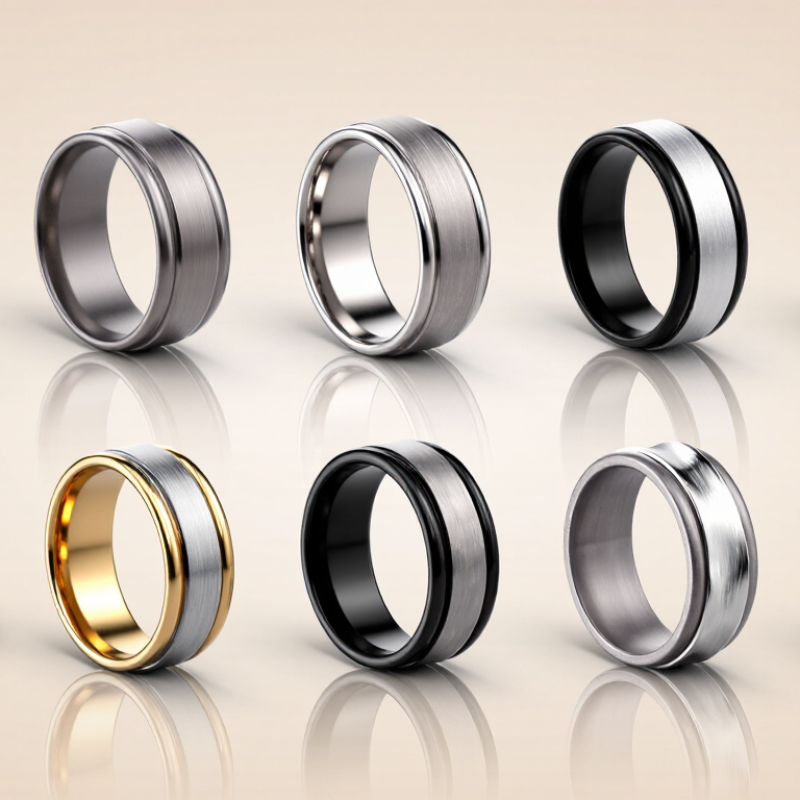
Comfort fit describes an inner ring profile with rounded edges. It reduces sharp pressure against the finger. ISO 8653 provides a standardized method for defining and measuring ring sizes. It does not classify comfort fit as a style. A size designation relates mainly to the ring’s internal measurement, often expressed through inner circumference. For example, size 60 broadly indicates about 60 millimeters inside. Width, metal thickness, temperature, and finger shape can still change the wearing experience.
The ten common comfort fit styles include classic court, half-round, domed, flat-edge, beveled, knife-edge, wide band, stacking band, signet, and patterned band designs. Their outer shapes differ, but their rounded interiors support easier movement over the knuckle. A wide band may need a slightly different fitting check than a narrow band. That detail is easy to miss.
In practical sizing, measure the finger at a normal temperature and compare the result with the ring’s internal dimensions. Try the ring several times. Fingers swell during the day, and one measurement may mislead. ISO alignment improves consistency, but it cannot replace a real fit assessment. A ring can meet a size standard and still feel uncomfortable. That limitation deserves more attention.

Comfort-fit rings use a rounded inner edge that reduces pressure during daily movement. In professional fitting, profile and width usually affect comfort more than appearance alone. My ranking considers wearability, metal behavior, and setting security.
1. Classic rounded band: low profile, 4–6 mm wide, in platinum or gold, with no setting.
2. Soft court band: medium profile, 5 mm wide, polished gold, ideal for continuous wear.
3. Low-profile solitaire: slim platinum or gold band with a small raised setting.
4. Comfort-fit flat band: 6–8 mm wide, titanium or gold, with softened edges.
5. Beaded-edge band: narrow, textured, and low profile, using durable platinum.
6. Channel-set band: medium width, white gold, with stones protected between metal walls.
7. Domed wedding band: rounded exterior, 5–7 mm wide, in yellow gold.
8. Milgrain band: low to medium profile, narrow width, often crafted in rose gold.
9. Tapered band: wider near the setting, slimmer underneath, with a secure low profile.
10. Hammered band: medium profile, 6 mm wide, using gold or titanium for visible texture.
Metal changes the experience. Platinum feels dense and resists surface loss, while gold offers warmer color and easier resizing. Titanium feels light, but resizing can be limited. Stone settings also need inspection; a comfortable edge cannot compensate for loose stones. Ring width matters most on larger fingers, where very broad bands may feel tight after heat or exercise. My ranking is not absolute. Finger shape, work habits, and swelling can change the result. A ring that felt perfect during a short fitting may become distracting after several hours.
Comfort fit describes a rounded inner surface, not one fixed exterior shape. Ten useful styles include classic court, D-shaped, flat, round, oval, soft-square, beveled, knife-edge, domed, and tapered bands. The classic court curves gently inside and out, spreading pressure across the finger. D-shaped bands look rounded outside but flatter within, so they can feel firmer. Flat bands offer a crisp, modern face; their edges may feel more noticeable. Round bands have a softer outline and often suit people who dislike sharp edges. Small details matter.
Width changes the experience. A wide flat band can feel snugger than a narrow court band in the same nominal size, while a rounded interior may slide over the knuckle more easily. ISO 8653:1986, the jewellery ring-sizing standard, defines ring size using inner circumference in millimetres. That measurement does not account for every profile or knuckle shape, so test the exact width and finish with a professional jeweller. A chart is only a starting point.
For daily wear, compare the ring after your hands warm up, then check whether it rotates or catches on fabric. Court and oval profiles usually feel smooth; beveled and knife-edge styles create a more defined ridge. Flat comfort-fit bands balance a broad look with a curved interior, though the extra metal can feel substantial. There is no universal winner. I would not assume “comfort fit” means comfortable for every hand; that label leaves out personal fit and habits.
A comfort-fit ring has a softly rounded inner edge, reducing pressure during daily wear. It does not automatically make every setting comfortable. In my fitting experience, the top ten styles include bezel, halo, pavé, channel, solitaire, three-stone, cathedral, low-profile, split-shank, and cluster designs. Finger shape, ring width, and metal thickness still matter.
Bezel comfort fits offer smooth outer edges and protect the center stone from bumps. They often feel secure, though a deep bezel can trap moisture underneath. Halo designs add sparkle around the center, but crowded edges may rub neighboring fingers.
Pavé settings look bright under light. Tiny stones can catch on sweaters, especially when prongs rise above the band. Channel settings feel comparatively smooth, yet dirt can collect inside the stone rows. Regular inspection helps.
Solitaire comfort fits remain practical for many wearers. Their open design allows easier cleaning and usually creates fewer contact points. However, a tall solitaire may snag during work or glove use. Low-profile versions reduce that issue. Three-stone and cathedral styles can balance visual weight, while split-shank and cluster designs may feel wider than expected. Try the ring for several minutes, bend your finger, and notice pressure near the knuckle. Small details matter. I would not treat “comfort fit” as a guarantee; one shape may suit a narrow finger poorly. A professional sizing check is still worthwhile.
Comfort-fit rings deserve more than a quick style ranking. The Knot’s 2023 Real Weddings Study placed average U.S. engagement-ring spending at $5,500. BriteCo’s 2024 Wedding Report estimated a higher average of $6,551. The difference matters. Survey methods, stone size, and metal choices can shift the benchmark.
For shoppers near $5,500, compare these ten comfort-fit styles: classic rounded, flat-edge, domed, beveled, knife-edge, stackable, hammered, milgrain, two-tone, and engraved bands. A rounded interior helps reduce pressure during long wear, especially with wider stackable or domed profiles. Hammered surfaces hide small scratches. Milgrain adds texture but may need careful cleaning. Two-tone designs create contrast without requiring a larger center stone. Practical experience suggests trying each ring for several minutes, not merely admiring it under bright showroom lights. Rotate your hand. Make a fist. Notice tight spots.
Price can support craftsmanship, but it cannot guarantee comfort. That is easy to forget. A $5,500 budget may cover a refined two-tone or milgrain ring, while a simpler hammered band may offer better daily value. Wider profiles can increase metal weight and cost. Intricate edges may also raise production time. The averages are useful, yet imperfect; they describe spending behavior, not personal fit. A ring should feel secure after handwashing, typing, and ordinary movement—not only during the proposal.
A practical comparison of comfort features, styling flexibility, durability, and typical U.S. retail pricing for plain or lightly detailed bands.
| Ring Style | Comfort-Fit Construction | Best Stacking Use | Comfort Rating | Typical Width | Common U.S. Retail Range* | Position vs. $5,500 Benchmark | Care Consideration |
|---|---|---|---|---|---|---|---|
| Classic Rounded Band | Rounded outer surface and smoothly finished inner edge reduce pressure during daily wear. | Works as a foundation band or paired with nearly any engagement-ring shape. | ★★★★★ | 2–6 mm | $400–$2,000 | Usually below | Low maintenance; check fit if the band is worn beside a wider ring. |
| Comfort-Fit Domed Band | A rounded interior allows the ring to slide over the knuckle more easily than a flat interior. | Provides a smooth, substantial base for narrow stacking bands. | ★★★★★ | 3–8 mm | $600–$2,800 | Usually below | The curved profile can rotate slightly on slender fingers. |
| Stackable Nesting Band | Usually thin, rounded, and lightly tapered to minimize gaps between multiple rings. | Designed for two or more bands; ideal for mixing widths and metal colors. | ★★★★☆ | 1.5–3 mm | $250–$1,800 | Usually below | Thin bands may show wear faster when stacked tightly. |
| Hammered Texture Band | A rounded inner surface preserves comfort while the hand-finished exterior disguises minor scratches. | Adds contrast beside polished, matte, or plain bands. | ★★★★☆ | 3–7 mm | $500–$2,500 | Usually below | Texture may soften over time through polishing and repeated abrasion. |
| Milgrain Edge Band | Comfort-fit interiors are paired with small bead-like edges that soften the visual transition. | Pairs well with vintage-inspired, engraved, or delicate rings. | ★★★★☆ | 2–5 mm | $600–$2,800 | Usually below | Small milgrain beads can flatten or wear with frequent impact. |
| Two-Tone Comfort Band | A rounded interior combines two metal colors while maintaining a smooth, snag-resistant finish. | Bridges mixed-metal stacks and coordinates with both warm and cool jewelry. | ★★★★☆ | 4–8 mm | $900–$3,500 | Usually below | Different metals can develop contrasting surface wear or patina. |
| Beveled-Edge Band | Angled edges are softened and the inner surface is rounded to avoid sharp contact with adjacent fingers. | Offers a clean geometric layer beside a round or oval engagement ring. | ★★★★☆ | 3–8 mm | $500–$2,600 | Usually below | Beveled edges can show dents or scuffs more visibly than rounded edges. |
| Channel-Set Low-Profile Band | Low-set stones and a rounded inner shank help reduce snagging and pressure points. | Creates sparkle without overwhelming a larger engagement ring. | ★★★★☆ | 2–5 mm | $1,000–$4,500 | Below to near | Stone channels should be inspected periodically for looseness or trapped debris. |
| Contoured or Curved Band | Its curved outline follows the profile of an engagement ring while the interior remains rounded. | Best for close-fitting stacks around raised, halo, or non-round center settings. | ★★★★☆ | 2–5 mm | $700–$3,500 | Usually below | Fit is more setting-specific and may be less versatile in future stacks. |
| Wide Cigar-Style Band | A rounded interior and softened edges improve comfort despite the ring's greater surface area. | Usually worn alone or paired with one delicate stacking band. | ★★★☆☆ | 7–12 mm | $1,000–$4,000 | Below to near | Wider bands often require a slightly larger size and may feel less breathable. |
*Pricing note: Ranges are broad planning estimates for common U.S. retail pricing of plain or lightly detailed bands in precious metals. Final prices vary by metal purity, ring width, finger size, gemstone weight, labor, and customization. The $5,500 figure is used only as the comparison benchmark stated in the title.
© 2023 Bird & Cronin, LLC. All Rights Reserved.

In observance of the 4th of July holiday, our offices will be closed on July 3rd & 4th.